
In Short: What Is a Hybrid Press Brake?
A press brake bends sheet metal between an upper punch and a lower V-die to produce angled parts. Press brakes are grouped by how they generate bending force: conventional hydraulic, fully electric and hybrid.
A hybrid (servo-hydraulic) press brake still produces force with hydraulic cylinders. The difference is that the oil pump is driven by a servo motor. The pump runs only when needed and at the speed required. As a result the machine does not waste energy while idle, the oil stays cooler, and motion can be controlled more precisely by the CNC.
How Does a Hybrid Press Brake Work?
A bending cycle can be summarized in five steps:
- Approach: The upper beam (ram) moves down quickly toward the sheet.
- Bending: Speed drops, the cylinders apply pressure and the sheet is bent to the angle of the die.
- Dwell: If needed, pressure is held for a short time to control springback.
- Return: The ram goes back up and the part is released.
- Positioning: The back gauge (X and R axes) positions the sheet for the next bend.
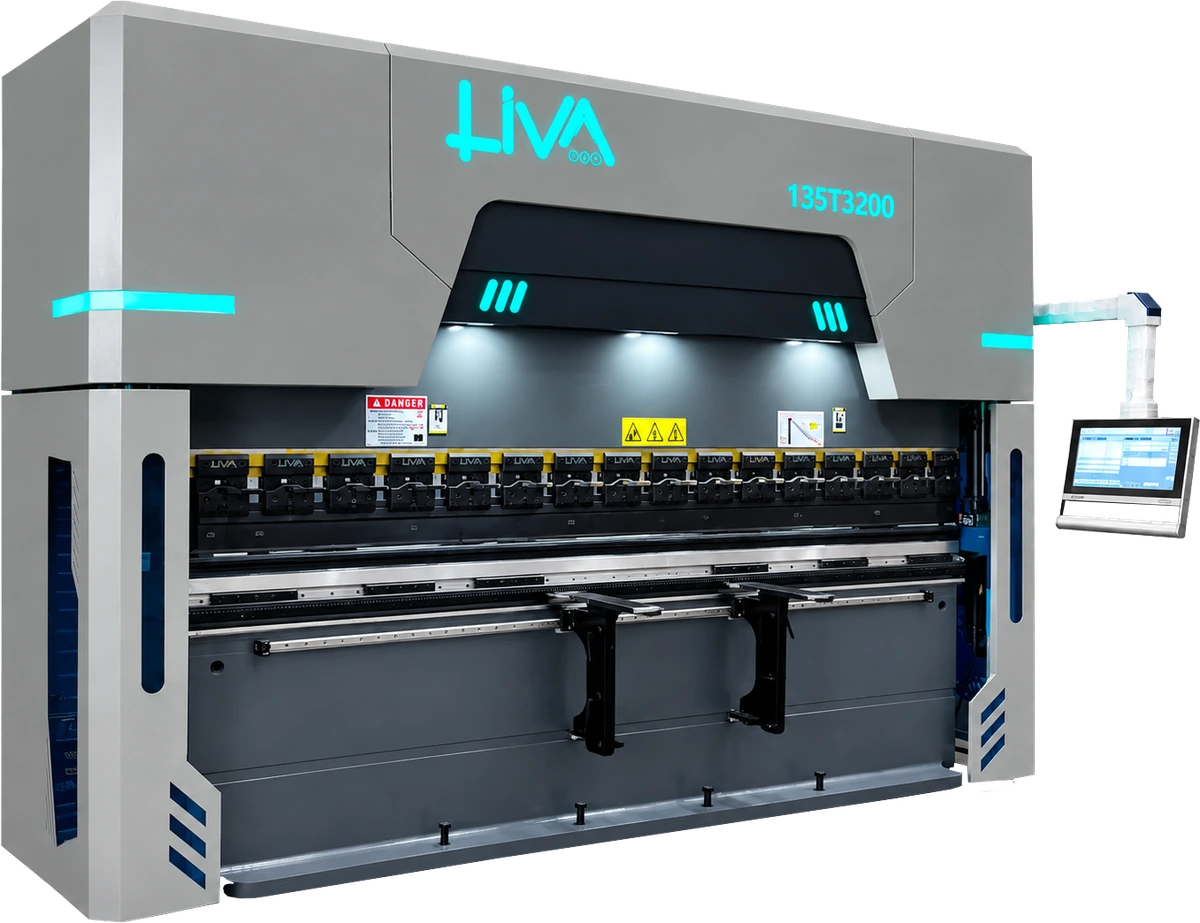
In a hybrid system these motions are managed by the CNC through the servo motor and pump. Because the ram is driven by two separate cylinders (Y1 and Y2), the control keeps both ends parallel for consistent angles along the bend. The machines in the Liva Abkant series use this layout with a DELEM 53TX controller and 4-axis (Y1, Y2, X, R) CNC control.
Hybrid Vs. Conventional Hydraulic Vs. Fully Electric
The table below shows general tendencies. Actual values vary by manufacturer and model, so always check the technical documentation of the machine you are considering.
| Feature | Conventional hydraulic | Hybrid (servo-hydraulic) | Fully electric |
|---|---|---|---|
| Force source | Continuously running pump and valves | Servo-driven pump, hydraulic cylinders | Servo motor and mechanical drive |
| Energy use | Draws energy while idle | Draws energy on demand | Draws energy on demand |
| High tonnage | Very common | Common | Usually limited to low and medium tonnage |
| Oil heating and noise | Higher | Lower | No oil |
| Maintenance | Oil, valves, filters | Oil and filters, less thermal load | Mechanical drive components |
| Initial investment | Usually lowest | Medium | Usually highest |
In practice, a hybrid press brake keeps the high tonnage and robustness of a hydraulic system while approaching the energy efficiency and precision of an electric machine.
Advantages of a CNC Hybrid Press Brake
- Lower energy consumption: The pump does not run continuously, which matters most during idle time and short cycles. The saving depends on your usage profile.
- Less heating: Oil stays cooler, which helps oil life and angle repeatability.
- Lower noise: The pump stops while the machine waits, so the shop is quieter.
- Precise, repeatable bending: Servo control can fine-tune ram position and speed.
- Fast cycles: Approach and return speeds can be kept high.
- Control integration: A modern CNC offers program storage, bend sequencing and automatic calculations.
Points to Consider
- The initial cost can be higher than a conventional hydraulic machine. Look at energy and maintenance costs as well as the purchase price.
- Service support for the servo drive and pump unit should be available in your region.
- Hybrid technology is not a must for every shop. For a shop that runs only a few hours a day with very few cycles, a conventional hydraulic machine can still be a sensible choice.
Where Is It Used?
Anywhere sheet metal is bent. Common areas include:
- Sheet metal shops and contract manufacturing
- Electrical panels, cabinets and enclosures
- Ventilation, heating and cooling equipment
- Elevator cabins and panels
- Appliances and commercial kitchen equipment
- Automotive supply industry and metal furniture
Buying Checklist
- Tonnage and bending length: Enough force for your thickest and longest part. See our guide How to choose press brake tonnage for a step-by-step calculation.
- CNC control: Ease of use, program memory and training support.
- Number of axes: X and R axes on the back gauge help with tapered and complex parts.
- Frame rigidity and crowning: Motorized crowning helps avoid angle deviation in the middle of long parts.
- Tooling system: A European-style (Promecam) holder makes tooling easy to find and change.
- Safety: Laser finger protection and side guards.
- Service and spare parts: Installation, training and after-sales support.
The Liva Abkant Series
The Liva Abkant series, Livamak's own brand, offers several tonnage and length options:
| Model | Press force | Bending length | Approx. tons per meter |
|---|---|---|---|
| LPB-2080 | 80 ton | 2030 mm | 39 |
| LPB-31135 | 135 ton | 3200 mm | 42 |
| LPB-31220 | 220 ton | 3200 mm | 69 |
All three models include a DELEM 53TX controller, 4-axis CNC, motorized crowning and laser finger protection. See the CNC press brake products page for details or request a quote.
Frequently Asked Questions
What is a CNC hybrid press brake?
A CNC-controlled press brake that produces bending force with hydraulic cylinders while the pump is driven by a servo motor. It combines the power of hydraulics with the efficiency of servo systems.
Does a hybrid press brake really save energy?
The pump runs only when needed, so it does not consume energy while the machine waits. The amount saved depends on your working pattern, cycle times and machine design, so giving an exact percentage would not be accurate.
Is a hybrid press brake more accurate?
Servo control can fine-tune ram position and speed, so repeatability is good. Final accuracy also depends on tooling quality, frame rigidity, crowning and the operator's setup.
What sheet thicknesses can be bent?
It depends on the tonnage and bending length of the machine. Calculate the force needed for your thickness, material and part length, and compare it with the machine's capacity.
Does a hybrid replace a conventional hydraulic press brake?
In many applications it can, but it is not mandatory. For low-use shops or tight budgets, a conventional hydraulic machine can still make sense.
How is it maintained?
Oil and filter changes, hose and fitting checks, cleaning of tooling and guides, and periodic calibration. Follow the manufacturer's manual for service intervals.