
First, a Short Summary
A press brake's capacity is described by two numbers: press force (tons) and bending length (mm). Three questions are enough to choose:
- What is your thickest and strongest material?
- How long is your longest part, in mm?
- Are your parts simple, or complex with many bends?
The first two answers set the tonnage and length. The third sets the number of axes and the control requirements.
How Is Tonnage Calculated?
For air bending, the most common method, the approximate formula for the required force is:
F = 1.42 × Rm × s² / V (kN/m)
- Rm: Tensile strength of the material (N/mm²). About 400 for mild structural steel.
- s: Sheet thickness (mm).
- V: V-die opening of the lower die (mm). Rule of thumb: 6 times the thickness up to 3 mm, and 8 times for 3 to 10 mm.
- To get tons, divide the kN value by 9.81, then multiply by the bending length in meters.
Example values for mild steel (Rm ≈ 400 N/mm²) calculated with this formula:
| Sheet thickness | V-die opening | Tons per meter | Total tons for a 3 m length |
|---|---|---|---|
| 1 mm | 6 mm | 9.7 | 29 |
| 1.5 mm | 9 mm | 14.5 | 43 |
| 2 mm | 12 mm | 19.3 | 58 |
| 3 mm | 18 mm | 29.0 | 87 |
| 4 mm | 32 mm | 29.0 | 87 |
| 5 mm | 40 mm | 36.2 | 109 |
| 6 mm | 48 mm | 43.4 | 130 |
| 8 mm | 64 mm | 57.9 | 174 |
These values are approximate guidance. Actual values vary with material strength, die geometry and bend angle. For an exact figure, use the tool and machine manufacturer's chart.
How Does Material Type Change the Tonnage?
- Stainless steel: Needs roughly 1.5 times the force of mild steel.
- Aluminum: Usually bends with less force than mild steel, depending on the alloy.
- High-strength sheet: Force increases in proportion to the Rm value.
Get the tensile strength of your material from its certificate or your supplier.
Example: Why Is 6 Mm × 3.2 M Borderline?
According to the table, 6 mm mild steel needs about 43 tons per meter. For a 3.2 m part the total force is about 139 tons. A 135-ton machine would be at its limit and would not run efficiently on this job. A 220-ton machine handles the same part comfortably.
For 4 mm at 3.2 m, about 93 tons are needed, which a 135-ton machine handles safely.
Rule of practice: Avoid running a machine at its limit all the time. Leaving a margin over the calculated force is good for both tooling and machine life.
How to Choose Bending Length
Bending length (table length) defines the longest part you can bend. When choosing, consider:
- Your longest part: Add some margin. If a longer job comes in, you avoid a new investment.
- Distance between housings: Needed so the edges of the part do not hit the side frames.
- Throat depth: Shows how far the bent edge can go into the machine on wide, deep parts.
- Tool length: Upper and lower tool segments can be combined in different lengths.
As a rule, a long machine can also serve short parts, but a short machine cannot serve long parts. However, price and floor space grow with machine size.
What to Check Beyond Tonnage
- Number of axes: X and R axes on the back gauge reduce setup time on varied and tapered parts.
- Crowning: Reduces angle deviation in the middle of long parts.
- Tooling system: Standard holders widen your tooling options.
- CNC control: Program storage, graphical interface and ease of training.
- Service support: Installation, training and spare parts.
Matching with the Liva Abkant Series
The table below shows the approximate tons-per-meter capacity of the Liva Abkant models. Compare it with the table above to make a rough preselection:
| Model | Press force | Bending length | Approx. tons per meter |
|---|---|---|---|
| LPB-2080 | 80 ton | 2030 mm | 39 |
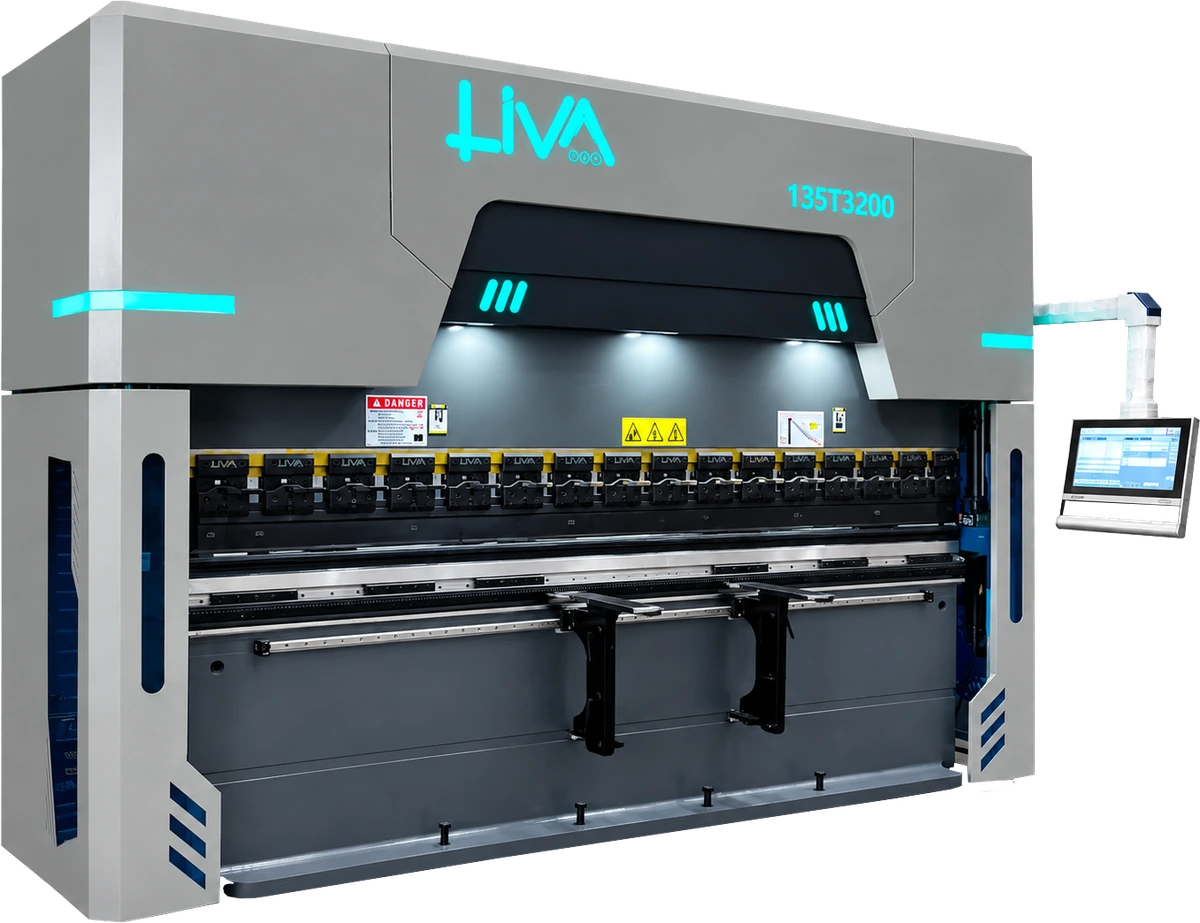
| LPB-31135 | 135 ton | 3200 mm | 42 |
| LPB-31220 | 220 ton | 3200 mm | 69 |
For example, 2 mm sheet needs about 19 tons per meter, which all three models handle easily. 6 mm sheet needs about 43 tons per meter, so the LPB-31220 is the better fit. For a clear recommendation for your own parts, send us your material, thickness and longest part length.
Frequently Asked Questions
How is press brake tonnage calculated?
Approximately with F = 1.42 × Rm × s² / V in kN/m. Divide by 9.81 and multiply by the bending length to get total tons. For an exact value, use the tool and machine manufacturer's chart.
How do I choose the V-die opening?
As a general rule about 6 times the sheet thickness up to 3 mm and about 8 times from 3 to 10 mm. A smaller V needs more force and gives a smaller inside bend radius.
How does tonnage change for stainless steel?
It needs roughly 1.5 times the force of mild steel.
Can I run the machine at full capacity?
Technically yes, but it is not recommended for tooling and machine life. It is healthier to leave a margin over the calculated force.
How long should the bending length be?
Slightly longer than your longest part. Also consider the chance of longer jobs in the future.
Which Liva press brake should I choose?
It depends on your material, thickest sheet and longest part. Send us your details and we will check the fit together.