
Why Is Compressed Air Used in Fiber Laser Cutting?
In laser cutting, the assist gas blows molten metal out of the kerf. The three most common options are oxygen, nitrogen and compressed air.
- Oxygen: speeds up cutting in carbon steel through an exothermic reaction. An oxide layer remains on the edge.
- Nitrogen: gives an oxide-free, bright edge in stainless steel and aluminum. Consumption is high and it is one of the biggest running costs.
- Compressed air: air is about 78% nitrogen and 21% oxygen. The gas cost is only the electricity and maintenance of the compressor. The edge may show light oxidation, so air is often chosen for parts that will be painted, welded or not seen afterwards.
Confirm which gas suits which job against your laser manufacturer's cutting table, based on your material and your customer's edge requirements.
Comparison of Assist Gases
| Feature | Oxygen | Nitrogen | Compressed air |
|---|---|---|---|
| Typical use | Carbon steel | Stainless, aluminum, bright edge | Thin and medium sheet; jobs where edge quality is not critical |
| Edge | Oxide layer | Oxide-free, bright | Light oxidation |
| Gas cost | Medium | High | Low (electricity and maintenance only) |
| Supply | Cylinders or tank | Cylinders, tank or generator | Produced on site |
In practice many shops work in a mix: nitrogen for stainless and bright-edge jobs, air for the rest.
Pressure: Why 16 Bar?
In air cutting, the speed of the gas leaving the nozzle and the pressure in the kerf decide how cleanly the molten metal is expelled. The thicker the sheet, the higher the pressure required. This is why 16 bar is a common working pressure for laser cutting compressors; some high-power systems need more.
The compressor's rated pressure must be higher than the pressure required at the nozzle inlet, because piping, dryer and filters cause pressure drop. Ask your laser manufacturer for the recommended pressure and connection size in writing.
How Is Air Flow Determined?
A laser's air consumption depends on nozzle diameter and pressure. The values below are an approximate engineering estimate for a single cutting head at 15 bar. Actual consumption varies with the head and settings, so confirm with the manufacturer.
| Nozzle diameter | Approx. air consumption (free air) |
|---|---|
| 1.5 mm | 0.3 m³/min |
| 2 mm | 0.5 m³/min |
| 3 mm | 1.1 m³/min |
| 4 mm | 1.9 m³/min |
Add a 20–30% safety margin on top of consumption. If other machines (pneumatic tools, press brake auxiliaries) use the same line, add their consumption too. If flow is insufficient, pressure drops and cut quality suffers.
Air Cleanliness: Dryer and Filters
Air for laser cutting must be oil-free, dry and dust-free. Moisture, oil or particles contaminate the protective window, lens and nozzle, reduce cut quality and increase maintenance cost.
- Refrigerated dryer: removes moisture from the air. The target is a pressure dew point of about 3-5 °C.
- Staged filters: primary dust, precision dust and activated carbon stages capture particles and oil vapor. The Liva HM series has 5 filter stages (C, T, A, X, FF) with 0.01 µm accuracy.
- Air tank: smooths pressure fluctuation and helps hold back moisture.
For very sensitive applications or humid regions an adsorption dryer may also be considered. Ask your laser manufacturer which air quality class (ISO 8573-1) is required.
Why an Integrated, Variable-frequency Screw Compressor?
Air consumption in laser cutting changes constantly: high while the head is cutting, lower when idle. A variable-frequency (inverter) screw compressor, which adjusts speed to the load, suits this well; a fixed-speed unit wastes energy cycling between load and unload.
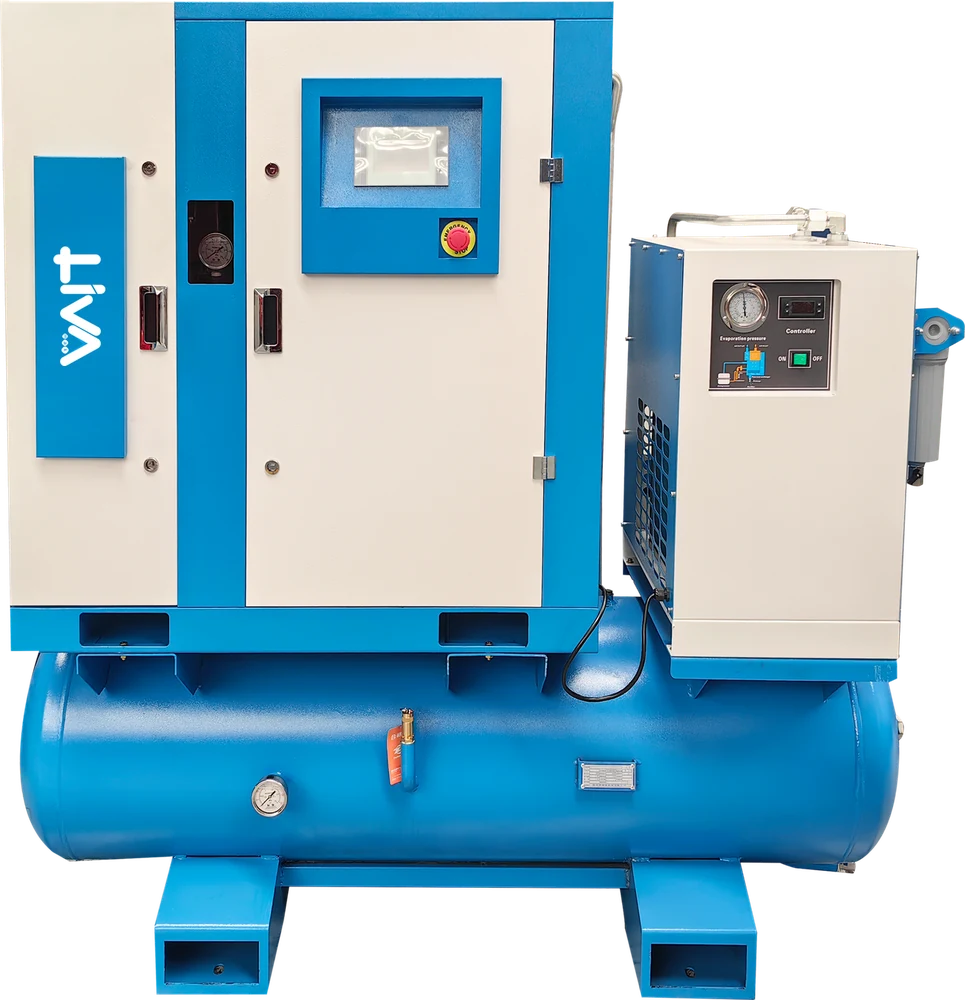
An integrated type combines compressor, dryer, filters and tank in one unit. It shortens piping, speeds up installation and saves floor space.
Liva HM Series Compressors
Livamak offers integrated screw compressors designed to work with fiber laser cutting machines:
| Model | Power | Pressure | Air delivery | Suitable laser power |
|---|---|---|---|---|
| HM-15 | 15 kW | 16 bar | 1.2–1.5 m³/min | 1500–3000 W |
| HM-20 | 22 kW | 16 bar | 2.4 m³/min | 6000 W |
Both models use a variable-frequency drive, air cooling and 380 V / 50 Hz power. The integrated type has a 340 L tank.
Installation and Maintenance Notes
- Ventilation: a compressor generates heat; do not place it in a closed, unventilated room. Ambient temperature should stay below 45 °C.
- Piping: a line of adequate diameter, as short as possible with few elbows, reduces pressure drop. Use a final filter before the connection to the laser.
- Drainage: drain tank and filter condensate regularly or use automatic drains.
- Periodic maintenance: oil, oil filter, oil separator and air filters should be replaced at the intervals recommended by the manufacturer.
To choose the right compressor for your laser together, browse our compressor products or request a quote. For choosing the laser itself, see our fiber laser buying guide.
Frequently Asked Questions
Can every material be cut with compressed air on a fiber laser?
Air is widely used on thin and medium sheet, but the edge may oxidize slightly. For stainless steel and aluminum jobs that need a bright, oxide-free edge, nitrogen is preferred. Check your laser manufacturer's cutting table for material and thickness.
What pressure is needed for a laser?
16 bar working pressure is common for compressors. The required value depends on cutting thickness and the laser manufacturer's recommendation; choose slightly higher compressor pressure to cover pressure drop in piping and filters.
How is compressor flow calculated?
The laser's consumption is determined from nozzle diameter and pressure, the consumption of other devices on the same line is added, and a 20-30% safety margin is left.
Are a dryer and filters mandatory?
Yes. Moisture, oil and particles contaminate the protective window and lens. A refrigerated dryer and staged filters are standard for laser cutting.
What is the difference between an integrated compressor and a separate-tank compressor?
In an integrated type the compressor, dryer, filters and tank are in one unit, so installation is fast and floor space is small. In a separate-tank arrangement the parts are placed separately, which allows a larger air storage volume.