
Define Your Needs First
Before comparing machines, answer these questions:
- Which materials will you cut? (carbon steel, stainless, aluminum, brass, copper)
- What is your thickest material, in mm?
- What is your largest sheet size? (for example 3000 x 1500 mm)
- Will you cut sheet, tube and profile, or both?
- How many shifts will it run and what is your monthly cutting volume?
These answers set the machine's power, table size and level of automation.
Laser Power
Laser power (kW) sets cutting speed and the maximum thickness you can cut, especially in thick material. As power increases, the machine cuts faster and thicker, but price and running cost also rise.
- If you cut only thin sheet, very high power is not necessary.
- If you cut thick steel or stainless, the speed difference at higher power is clear.
- Choose power for the thickness you cut most often, not for the thickest material you cut rarely.
Ask the manufacturer for a thickness table by material type; gas type and edge quality should be stated in it.
Table Size and Loading
- Table size: A common size is 3000 x 1500 mm (3015). Larger tables exist for wide parts.
- Pallet changer: A dual-pallet system lets you prepare the next sheet while cutting continues, reducing machine idle time.
- Automatic loading and unloading: Saves labor and time at high volume.
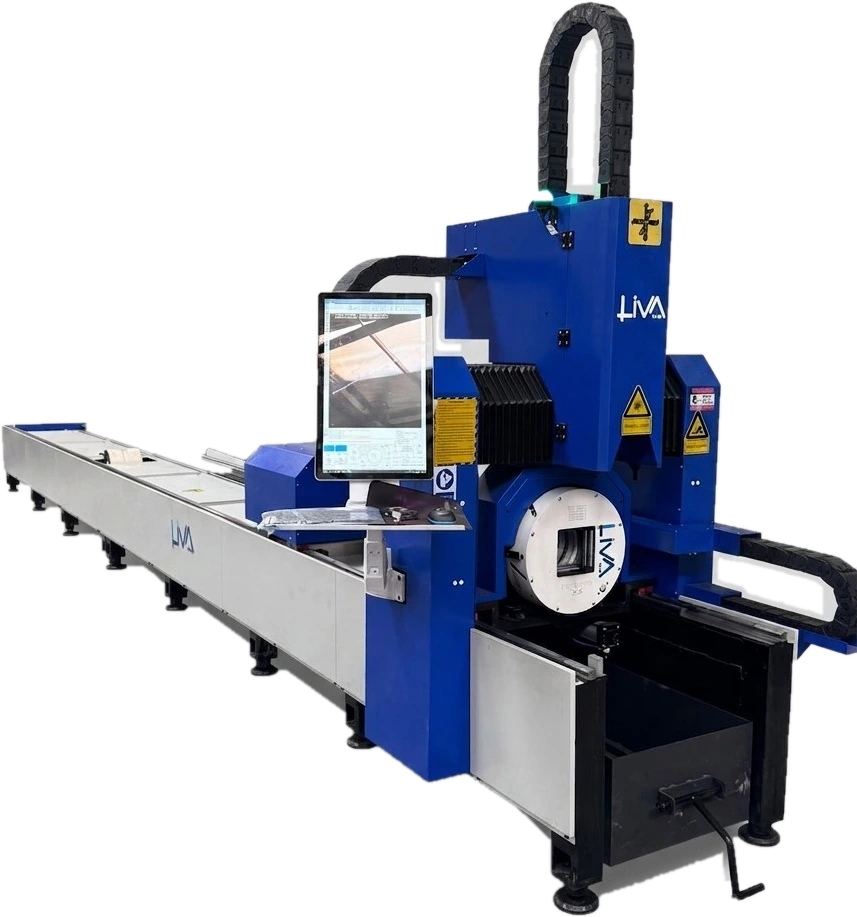
- Tube and profile cutting: If you cut both sheet and tube, integrated systems do both jobs in one machine.
In our product groups you can find sheet, tube-profile and combined sheet-and-tube laser cutting options.
Cutting Head, Control and Software
- Cutting head: Automatic focus and collision protection save time when switching between thick and thin material.
- CNC control: Ease of use, program storage and interface language.
- Nesting software: Arranges parts efficiently on the sheet and directly affects scrap rate.
- CAD compatibility: Smooth import of DXF and similar files.
Assist Gas and Running Cost
The assist gas used in cutting determines cost and edge quality:
- Nitrogen: Gives oxide-free, clean edges on stainless steel and aluminum. Consumption is high.
- Oxygen: Used on carbon steel, especially thick sheet.
- Air: An economical option for thin sheet; edge quality depends on your requirements.
Add gas, electricity, consumables (nozzles, lenses) and maintenance costs to the purchase price to calculate the total cost of ownership.
Infrastructure and Safety
- Electricity: Required power and connection type.
- Cooling (chiller): Needed for the laser source and cutting head.
- Air and gas supply: Compressor, nitrogen tank or generator.
- Fume and dust extraction: Needed for a healthy work environment.
- Floor and space: Machine weight and installation area.
- Enclosure and safety: Standard features that protect against the laser beam.
Service and After-sales
With laser machines, after-sales support is often the most critical issue:
- Scope of installation and commissioning
- Operator training
- Warranty period and coverage (especially for the laser source)
- Spare parts supply and response time of the service team
- Remote support options
Short Checklist
- Are your materials and thickest cutting needs clear?
- Does the laser power match those needs?
- Are the table size and loading system sufficient?
- Do you need tube and profile cutting?
- Have you calculated gas and consumable costs?
- Is the infrastructure (electricity, cooling, air) ready?
- Are installation, training, warranty and service clear?
To find the right model together, send a quote request.
Frequently Asked Questions
Which materials can a fiber laser cut?
Mainly carbon steel, stainless steel and aluminum, as well as metals such as brass and copper. On reflective metals, power and model choice matter.
How many kW of laser power should I choose?
Choose for the material and thickness you cut most often. Higher power gains speed in thick material, but on thin sheet it only raises the investment.
Should I use nitrogen or oxygen?
Nitrogen gives clean edges on stainless steel and aluminum, while oxygen is used on carbon steel, especially thick sheet. Air is an economical alternative for thin sheet.
Is a pallet changer necessary?
At high volume it reduces machine waiting time. At low volume it is not essential.
Can sheet and tube be cut on the same machine?
Yes. Combined sheet-and-tube laser cutting machines are designed for this.
What matters most when buying?
Power suited to your material and thickness, table size, total running cost and after-sales service support.